“equatorial growth” search results (100)
Coffee treasures from the hometown of the giant tortoise in the equatorial coffee producing area, St. Cristobal in the Galapagos Islands.
A coffee treasure from the hometown of giant turtles in the Galapagos Islands, this coffee treasure is of excellent quality and is grown without any chemicals. Coffee is grown in San Cristobal (SaintCrstbal). St. Cristobal is a larger island in the Galapagos Islands (GalapagosIslands) and the only one in the archipelago with plenty of fresh water. On the island
2016-04-07 Equator coffee origin giant turtles hometown treasures Lapa Goss archipelago Chris
Introduction to Galapagos Coffee with Unique Aroma of Ecuadorian Coffee Estate
Creative coffees made from Ecuadorian coffee beans with unique aromas are also popular with consumers. Mr. Veniso, winner of the 2014 Ecuadorian Coffee Competition, won the Ecuadorian Coffee Competition with his creative formula. One espresso is fresh and distinctive with mint from the Amazon, and the other adds Rolls Royce to roses
2016-07-13 features unique aromas ecuador coffee manor appellation presentation lapa go
Introduction to the description of the fresh flavor of coffee varieties in Santa Cruz, Ecuador
When Thomas and the crew landed on the island, they were frantically looking for water and were so thirsty that they squeezed juice from the fat leaves of the cactus to drink. At last a source of water was found in a rocky gully. Thomas attributed it to the gift of God, because it was good Friday, and they had piously celebrated mass before they set out in search of water. But Thomas will never
2016-09-27 Taste new Ecuador Crewe manor coffee variety flavor description introduction
Introduction to the coffee flavor and taste of Santa Cruz Manor in Ecuador with a hint of flowers and fruits.
St. Cristobal is a larger island in the Galapagos archipelago. At 410m above sea level, there is a small lake called El.Junco, which forms streams along the rocks and volcanic rocks on the southern slope of the island. Mineral-rich fresh water moistens the land of St. Cristobal, keeping the soil moist and fertile. For here.
2016-09-09 With light flowers and fruits fragrant Ecuador Crewe manor coffee flavor![[Vanke Jinyu International] V+Cafe Coffee Shop opened on December 5th](https://www.coffeesearch.net/uploads/151203/2-15120314524DD.jpg)
[Vanke Jinyu International] V+Cafe Coffee Shop opened on December 5th
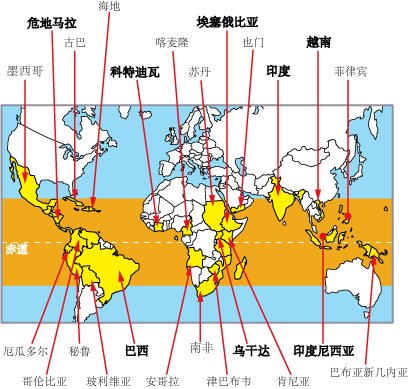
Before you took that full-bodied, smooth, roasted and well-balanced cup of coffee, you probably didn't think about where that perfect cup of coffee came from. A good cup of coffee starts with coffee beans. There are more than 60 coffee producing countries in the world, mainly in Brazil, Colombia, Indonesia and Vietnam, but good coffee beans are mostly concentrated in the equatorial zone between 25 degrees north latitude and 30 degrees south latitude.
2015-12-03 Vanke Jinyu International V+Cafe Coffee Shop December Sunshine Open
Introduction to the characteristics of coffee flavor and taste varieties in Hassanda Coffee Garden with the best quality
However, in the early 1990s, the Gonzalez family bought the Hasunda Coffee Garden. The local microclimate caused by the Humboldt current (Humboldt Current), strong equatorial sunlight and sharp temperature changes (43 ℃ at sea level and 10: 16 ℃ at 275m above sea level) provide a unique advantage, prompting the Gonzalez family
2016-09-13 Quality good Hasunda coffee garden coffee flavor taste variety producing area special
Arabica coffee (what is Arabica?) What are Arabica coffee beans?
There are various Coffea species, but the two most common are Coffea Arabica and Coffea Canephora, commonly known as Arabica and Robusta. Arabica grows in the tropical and equatorial strips of America, Africa and Asia and it is the most de
2015-11-09 Rabbi coffee what Arabica coffee beans Ther
Grade A coffee producing area of Ecuador, Santa Cruz, Galapagos Islands.
As coffee is consumed by people all over the world, the world coffee industry is also moving towards mass production, while St. Cristobal, a small and unreliable coffee industry, is in trouble and is likely to be forced to give up without profit. It wasn't until the early 1990s that the Gonzalez family bought Hasunda Coffee Park. Humboldt current (HumboldtC
2016-06-30 Ecuador coffee producing areas Lapa Goss archipelago Crewe Zizi island along with
Introduction to the Galapagos Islands Coffee producing area Santa Cruz Island
In the early 1990s, however, the Gonzalez family bought Hasunda Coffee Park. The local microclimate caused by the Humboldt current (Humboldt Current), strong equatorial sunlight and sharp temperature changes (43 ℃ at sea level and 10: 16 ℃ at 275m above sea level) provide a unique advantage, prompting the Gonzalez family to expand its coffee.
2016-06-20 Lapa Goss archipelago coffee producing areas introduction Crewe Zizi Island and in the 20th century
The taste is rich and perfect. Kenya Berman Estate Coffee Flavor Description Grind Treatment Method Mouth
Kenya has a total population of 41.8 million (2013) and a population growth rate of 2.7%. There are 42 ethnic groups in the country, mainly Kikuyu (17 per cent), Luhia (14 per cent), Kalenjin (13 per cent), Luo (10 per cent) and Kamba (10 per cent). In addition, there are a small number of Indians, Arabs and Europeans. Kenya's mineral deposits mainly include soda ash, salt, fluorite, limestone,
2016-10-06 Taste Rich Beautiful Kenny Abel Manor Coffee Flavor Description Grind
The flavor of Kenyan coffee is still strong. Introduction to the taste of fine coffee with grinding degree.
Kenya has a total population of 41.8 million (2013), with a population growth rate of 2.7 per cent. There are 42 ethnic groups in the country, including Kikuyu (17%), Lucia (14%), Kalenjin (13%), Luo (10%) and Kangba (10%). In addition, there are a small number of Indo-Pakistani, Arab and European Kenyan mineral deposits, mainly soda ash, salt, fluorite, limestone,
2016-09-28 Taste still thick Kenya coffee flavor description grinding boutique introduction
Introduction to the flavor description of moderate and mellow coffee varieties in Santa Cruz, Ecuador
When Thomas and the crew landed on the island, they were frantically looking for water and were so thirsty that they squeezed juice from the fat leaves of the cactus to drink. At last a source of water was found in a rocky gully. Thomas attributed it to the gift of God, because it was good Friday, and they had piously celebrated mass before they set out in search of water. But Thomas will never
2016-09-26 Medium thick Ecuador Crewe Manor Coffee Variety producing area Flavor description
The production of coffee, the planting technology of coffee manor.
Arabica coffee and Robbite coffee are harvested once every 3 to 4 years, and their lifespan varies due to different production conditions and different degrees of care (usually 20 to 30 years, after which they have to be replanted). Both varieties need plenty of sunlight and moisture. Arabian coffee trees like the seasonal climate of 15-24 ℃; Robbins like warm.
2016-06-06 Coffee yield planting technology manor Arabian coffee Robbins all 4
The treatment of Ecuadorian Coffee introduces the production of Santa Cruz in the Galapagos Islands.
In the early 1990s, however, the Gonzalez family bought Hasunda Coffee Park. The local microclimate caused by the Humboldt current (Humboldt Current), strong equatorial sunlight and sharp temperature changes (43 ℃ at sea level and 10: 16 ℃ at 275m above sea level) provide a unique advantage, prompting the Gonzalez family to expand its coffee.
2016-07-13 Ecuador coffee treatment method introduction Lapa Goss archipelago gram
Introduction of Ecuadorian coffee with fresh and unique taste
In the mid-15th century, there were legends about enchanted mysterious islands among fishermen fishing in the western Pacific Ocean of South America. It is said that the islands can sometimes be seen clearly from a distance, but when the ship approaches, it disappears again; sometimes it looks like a galleon, sometimes it shows the shape of a witch. The fishermen called these islands Magic Island and thought it was there.
2016-09-23 Taste freshness uniqueness Ecuador coffee variety flavor boutique introduction 1
Aromatic Ecuador Santa Cruz Manor Coffee Flavor Description Variety Features Introduction
When Thomas and his crew landed on the island, they frantically searched for water and were so thirsty that they squeezed juice from the fat leaves of cacti to drink. Finally found water in a ravine in a rock. Thomas attributed it to God because it was Good Friday and they had celebrated Mass piously before setting out in search of water. But Thomas would never
2016-09-28 Aroma Overflow Ecuador Crewe Manor Coffee Flavor Description Variety Yield
The growth cycle and picking time of coffee
Coffee beans are the seeds of coffee trees. After three or four years of growth, the coffee tree matures and begins to bear fruit, with one fruit arranged in clusters or clusters along the branches.
2014-05-13 Coffee knowledge growth cycle picking
Fresh and unique flavor description of Ecuadorian Santa Cruz Manor Coffee Variety treatment
Galapagos Islands coffee is recognized as green natural coffee, because the Ecuadorian government has designated the islands as a national park, not only does it no longer allow the reclamation of new agricultural land, but also forbids the use of chemical fertilizers, pesticides, herbicides and other chemicals. Although the elevation of about 200m on the island is very low, the climate of this area is equivalent to terrestrial 1000m1800m due to the special influence of the sea.
2016-09-29 Taste fresh unique Ecuador Crewe Manor Coffee Flavor description Product
Galapagos coffee producing area Galapagos coffee flavor
Coffee is grown in San Cristobal (SaintCristobal). Arab bourbon coffee trees are planted in the Hasunda Coffee Garden (HaciendaElCafetal) in San Cristobal. The elevation of the plantation is between 140 and 275 meters above sea level, and the climate in this area is equivalent to that between 915 and 1830 meters inland. This gradient is very suitable for the growth of high acidity extra hard coffee beans (SHB).
2016-08-31 Lapa Goss Goss.
Ecuador coffee estate producing area flavor taste characteristics boutique coffee beans introduction
The country is divided into three parts: the western coastal area, the central mountainous area and the eastern area. Map of Ecuador Map of Ecuador Western coast: including coastal plains and foothills, east high west low, generally below 200 meters above sea level, there are some hills and low mountains 600~700 meters above sea level. Tropical rain forest climate, the southernmost start to transition to a savanna climate. Average annual precipitation from north to south 3
2016-08-15 ecuador coffee estate region flavor taste characteristics boutique coffee beans